

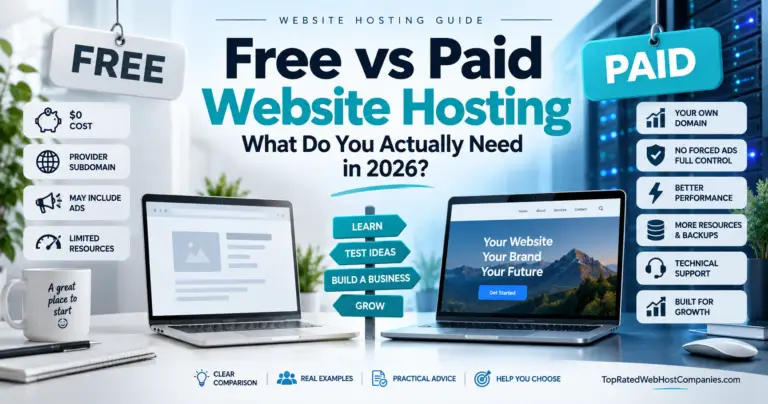
Free website hosting can make sense for learning, testing an idea or putting a simple personal project online. But for a business website, affiliate site or anything you expect to grow, paid hosting usually gives you substantially more control over your domain, branding, performance, backups and support.
The important question isn’t simply “Can I host a website for free?” It’s what will the free option stop me from doing later?
Free vs Paid Website Hosting: Quick Comparison
| What matters | Free hosting | Paid hosting |
|---|---|---|
| Cost | $0 to get started | Usually a recurring monthly or annual cost |
| Domain name | Often uses a provider-branded subdomain | Usually allows your own domain |
| Branding & ads | May include provider branding or advertising | Generally gives you full control |
| Storage & resources | Usually limited | More generous and scalable |
| Performance | Can be limited by shared resources and plan restrictions | Generally more resources and optimisation options |
| Backups & security | Varies considerably between providers | Often more tools, backups and security options available |
| Support | Usually limited or self-service | Typically greater access to technical support |
| Growth | Fine for simple projects, but restrictions can become an issue | Better suited to sites expected to grow |
| Best for | Learning, testing, hobbies and simple personal projects | Businesses, serious blogs, affiliate sites and growing websites |
Our view: Free hosting isn’t automatically bad hosting. If you’re learning, experimenting or simply want to put something online, it can be exactly what you need. But if the website is intended to become a business asset, earn income or grow substantially, we would normally start with paid hosting rather than build around restrictions we’ll probably need to remove later.
What is Free Website Hosting?
Free website hosting is a service that lets you publish a website without paying a regular hosting fee. The provider gives you space and resources on its servers so people can access your site online.
The trade-off is usually less control. Depending on the provider, a free plan may limit storage, bandwidth, features, support, custom domains or what you can do with the site. Some free services also display their own branding or advertising.
It is also worth understanding that “free website hosting” can mean several different things. A free plan from a website builder such as Wix is not quite the same as a free WordPress.com site, and neither is the same as hosting a static website through a service designed for developers.
That distinction matters because the limitations — and what happens when you eventually want to grow — can be very different.
When Free Website Hosting Is Actually a Good Choice
Free hosting makes the most sense when the website itself isn’t yet a critical business asset. There are plenty of situations where paying for hosting from day one simply isn’t necessary.
You are learning how websites work.
If you’re experimenting with website building, WordPress, HTML or design, a free option gives you somewhere to practise without another subscription to pay.
You are testing an idea.
Not every idea needs a domain name, premium hosting and a collection of paid tools before you know whether it has legs. A free site can be a practical way to build a simple proof of concept.
It is a personal or hobby project.
For a small site created primarily for yourself, family, a club or a hobby, the restrictions of free hosting may not matter at all.
You need something temporary.
A short-lived project or experimental site may never need the resources and flexibility that come with a paid hosting account.
You genuinely don’t need the extras.
If a provider’s free plan gives you everything you need, there is little sense in paying merely because paid hosting is considered the more “professional” option.
The key is knowing what you’re building. Free hosting becomes less attractive when the website needs to generate income, represent a business professionally, handle important customer interactions or grow significantly over time.
When We Would Choose Paid Hosting Instead
For websites we expect to become genuine assets, our approach changes. Once a site needs to attract customers, earn income, rank competitively in search results or grow over several years, we would normally choose paid hosting from the beginning.
You are building a business website.
Your website may become one of the main ways customers find, assess and contact your business. Having control over your domain, branding, backups and the way the site operates becomes much more important.
You want the website to earn money.
For an affiliate site, content business, membership site or online store, we’d rather build on hosting that gives us room to grow than discover later that an important feature is restricted by the free plan.
You expect traffic and content to grow.
A five-page experimental website has very different requirements from a site that may eventually contain hundreds of articles, images, landing pages and other resources.
You need dependable support.
When something breaks on a hobby site, waiting may be inconvenient. When something breaks on a site generating enquiries or income, getting help quickly can become considerably more important.
You want greater control over the website.
Paid hosting generally gives you more freedom over domains, email, backups, security, plugins, databases and other technical aspects of the site, although exactly what is included varies considerably between hosting companies and plans.
From our experience: We build and manage websites ourselves, and once a site is intended to become a long-term business or income-producing asset, we prefer having control over the hosting environment rather than designing the site around the limitations of a free plan. That doesn’t mean buying the most expensive hosting available — it means choosing enough hosting for what the website actually needs.
If you’re building a smaller business site, our guide to website hosting for small to medium businesses looks more closely at the hosting requirements worth considering.
What Does “Free” Website Hosting Really Cost?
The price on the checkout screen might be $0, but that doesn’t necessarily mean a free website has no cost. Sometimes the real cost appears later — when you want your own domain, need more storage, remove provider branding, add functionality or move the website somewhere else.
Here are the costs we would think about before choosing a free plan.
Your own domain name.
A free plan may give you a provider-branded web address rather than letting you use your own domain. If the website is going to represent a business or brand, owning and using your own domain can become important very quickly.
Provider branding or advertising.
Some free services may display their own branding or advertising on free websites. That might be perfectly acceptable for a test site or hobby project, but less appealing on a website you’re presenting to customers.
Features you discover you need later.
The feature you need six months from now may be the one that requires an upgrade. That could include additional storage, ecommerce features, analytics, email, backups, plugins or other functionality, depending on the platform.
Your time.
This is one of the easiest costs to overlook. If you spend dozens of hours building a website around a free platform and eventually discover that it cannot do what you need, migrating or rebuilding it can cost far more in time than inexpensive hosting would have cost in the first place.
The cost of moving.
Some websites are relatively straightforward to migrate. Others aren’t. Before committing substantial time to any free platform, check what happens if you eventually want to leave: Can you export your content? Can the whole site be transferred? Will the design need rebuilding?
A useful rule: Don’t ask only, “What will this cost me today?” Ask, “What will it cost me if this website succeeds?”
Free WordPress.com vs Self-Hosted WordPress: What’s the Difference?
One of the most confusing things for beginners is that WordPress.com and WordPress itself are not quite the same thing.
With WordPress.com, the hosting is provided for you. You can start with a free plan and don’t need to arrange a separate web host. That simplicity can make it appealing when you’re learning or just want to get something online quickly.
With self-hosted WordPress — often referred to as WordPress.org — you use the WordPress software but arrange your own hosting with a hosting company. You normally pay for that hosting, but you have much greater control over where the website lives and how it is set up.
If you’re planning to build your own WordPress site, our guide to building a WordPress website with Astra walks through the process in more detail.
A simple way to think about it
WordPress.com:
“Give me somewhere to build and host my WordPress website.”
Self-hosted WordPress:
“I’ll choose the hosting company, and I’ll run WordPress on that hosting.”
Neither option is automatically right or wrong. They simply suit different needs.
For someone experimenting with blogging or learning how WordPress works, starting free can make sense. But if we’re building a business website, affiliate site or another website we expect to develop into a long-term asset, we generally prefer self-hosted WordPress because of the additional control and flexibility it gives us.
From our experience: The hosting decision becomes much more important once a website starts growing. Being able to choose the host, move the site, manage backups and security, and change the setup as requirements evolve gives us considerably more flexibility than we need for a simple experimental website.
What About Wix and Other Free Website Builders?
Free website builders such as Wix can be another way to get a website online without immediately paying for conventional web hosting. But it helps to understand that a website builder and a traditional hosting account are not quite the same thing.
With a website builder, the platform generally provides the hosting, editing tools and much of the technical infrastructure as one service. You build the website inside that ecosystem rather than choosing a separate host and installing your own website software.
That can be a real advantage.
Website builders can be remarkably quick.
If your priority is getting an attractive, straightforward website online without dealing with hosting control panels, software installations or much of the technical setup, a website builder can make the process considerably easier.
Free plans are useful for experimenting.
They can give you an opportunity to learn the platform and build something before deciding whether the project justifies paying for it.
The trade-off is usually flexibility.
As your requirements become more complicated, you may find that particular features, your own domain, additional storage, ecommerce tools or other functionality require a paid plan.
The bigger question is therefore not whether Wix or another website builder is “good” or “bad”. It is whether the platform suits what you intend the website to become.
From our experience: We’ve built websites using both traditional WordPress hosting and Wix. Wix can be extremely useful when speed and simplicity matter — we’ve built functional sites surprisingly quickly with it. For projects where we want greater control over hosting, portability and the underlying website environment, we tend to favour self-hosted WordPress instead.
Can You Start With Free Hosting and Upgrade Later?
Yes — in many cases you can start with a free option and move to something more capable later. But there is an important distinction between upgrading your existing plan and moving your website somewhere else.
If the free provider also offers paid plans that meet your future needs, upgrading may be relatively straightforward. You may be able to add your own domain, increase resources or unlock additional features without rebuilding the website.
Moving to an entirely different platform or hosting company can be a different story.
Your content may be easy to move, but your design may not be.
Depending on the platform, you might be able to export pages, posts or other content while still needing to recreate parts of the website elsewhere.
Your domain needs to come with you.
If you own your domain separately, moving the website doesn’t mean losing the address people already know. This is one reason we like having clear ownership and control of important domain names from the beginning.
Email needs consideration too.
If business email is connected to your domain or hosting account, a move needs to be planned carefully so that changing website hosting doesn’t unexpectedly interrupt email.
Backups matter before any move.
Before migrating an established website, we want a usable backup rather than assuming everything will transfer perfectly the first time.
From our experience: We’ve moved and rebuilt enough websites to know that migrations can range from remarkably easy to unexpectedly awkward. Starting free isn’t necessarily a mistake — but before investing months or years into a platform, we want to know what the exit route looks like.
How Much Does Paid Website Hosting Cost?
Paid website hosting doesn’t necessarily mean spending a large amount of money.
For a straightforward blog, portfolio or small-business website, entry-level shared or WordPress hosting can still cost less than many everyday subscriptions. The price rises as you need more websites, storage, processing resources, managed services or more powerful hosting such as VPS or cloud infrastructure.
As a current Australian example, VentraIP advertises entry-level Business and Custom cPanel hosting from A$5.50 per month on its introductory offer, while its WordPress hosting currently starts from A$9.25 per month. Those introductory offers are discounted from the regular rates, so the renewal price matters just as much as the headline price.
Hostinger’s Australian 2026 pricing currently starts from A$4.39 per month for its Premium web-hosting plan when purchased on the advertised long-term term. Again, the commitment period and eventual renewal price need to be considered rather than comparing the promotional monthly number in isolation.
The important point is that moving from free to paid hosting doesn’t automatically mean jumping to an expensive server.
For many new websites, the sensible progression is:
Free hosting → useful for learning and testing
Entry-level paid hosting → suitable for many blogs and small websites
More capable shared/cloud hosting → for growing or more demanding sites
VPS or other advanced hosting → when the website genuinely needs additional resources or control
From our experience: We don’t automatically put every website onto the most powerful hosting available. Across the sites we manage, the hosting requirements vary considerably. Matching the hosting to the job is usually more sensible than paying for resources a small website may never use.
We’re preparing a separate guide to how much website hosting costs in Australia in 2026, where we’ll compare introductory prices, renewal costs and what you actually receive for the money. Once that guide is live, we’ll link to it here.
You can also explore our hosting reviews for 2026 for a closer look at the hosting providers and options we’re assessing.
Free Hosting Options Worth Knowing About in 2026
There are still legitimate ways to put a website online without paying for conventional hosting. The important thing is understanding what type of free service you’re actually getting and what limitations come with it.
We wouldn’t choose between these purely by asking which one gives you the most storage. They are designed for quite different users.
WordPress.com Free
WordPress.com still offers a free plan with hosting included. Current free sites receive a WordPress.com subdomain, 1GB of storage, unlimited pages and posts, basic traffic statistics and built-in security features.
There are important trade-offs. Free WordPress.com sites display WordPress.com advertising, and using your own custom domain as the site’s primary address requires a paid plan.
Best suited to: someone learning WordPress, starting a personal blog or experimenting before committing to a paid website.
Things to consider: the WordPress.com subdomain, advertising and the restrictions of the free tier compared with paid WordPress.com or self-hosted WordPress.
Wix Free
Wix also allows you to build and host a website without paying for a hosting plan.
Its current free hosting provides a Wix-branded wixsite.com address. Wix’s documentation currently lists up to 500MB of storage, while its support pages describe free-tier bandwidth limits that can vary by context; upgrading provides more resources and allows you to connect a custom domain.
Best suited to: someone who wants a visual website builder and values ease of setup more than control over the underlying hosting environment.
Things to consider: the Wix-branded address on the free tier, resource limits and whether the website may eventually need features that require upgrading.
Git-Based Static Hosting
There is another category that is quite different from WordPress.com or Wix: services designed primarily for static websites and developers.
For example, Cloudflare Pages has a free tier capable of hosting static sites, with static asset requests free and unlimited. Its current Free plan allows up to 500 builds per month, 20,000 files per site and up to 100 custom domains per project.
That can be remarkably capable for the right project, but it isn’t the same experience as logging into WordPress and creating pages with a visual editor.
Best suited to: developers, technically confident users and static sites that don’t require a conventional WordPress hosting environment.
Things to consider: the technical knowledge required and whether the website needs server-side applications, databases or other functionality beyond a static site.
Which Free Option Would We Choose?
That depends entirely on the job.
For learning WordPress, we’d look at WordPress.com.
For quick visual experimentation, Wix can make sense.
For a developer-built static project, services such as Cloudflare Pages can provide an extraordinary amount of hosting for nothing.
But for a website we’re building to become a business asset, substantial content site or income-producing project, we would normally move beyond the free tier and choose the hosting environment based on what that website needs.
Free hosting is most useful when it removes the cost of experimenting. It becomes less useful when its limitations begin dictating how an important website can grow.
Free or Paid Hosting: Which Should You Choose?
There isn’t one answer that suits every website. The right choice depends less on whether free or paid hosting is theoretically “better” and more on what you are trying to build.
I’m Learning How to Build Websites
Start free if you want to.
If you’re learning WordPress, experimenting with design or simply trying to understand how websites work, paying for hosting isn’t necessarily your first priority.
A free platform gives you room to make mistakes, experiment and decide whether you even enjoy building websites before spending money.
If the project becomes something worth developing further, you can then decide whether upgrading or moving makes sense.
I’m Testing a Business Idea
Free can be useful for the experiment — but think about what happens if it works.
If you’re testing whether people are interested in an idea, a simple free website may be perfectly adequate.
But if customers begin visiting, contacting you or relying on the site, we’d start thinking about your own domain, professional email, reliable backups and a hosting environment that gives the project room to develop.
I’m Building a Small-Business Website
We would normally choose paid hosting.
The website is representing the business. It may need to generate enquiries, appear in search results, use a professional domain and email address, and remain available when customers need it.
That doesn’t mean a small business needs expensive hosting. An appropriate entry-level paid plan may be perfectly sufficient.
I’m Starting a Blog or Content Website
This depends on your ambitions.
If you’re writing purely for enjoyment, a free blogging platform may provide everything you need.
If you’re building the blog with the intention of attracting substantial search traffic, monetising it through advertising or affiliate marketing, building an email audience or eventually turning it into a business, we would favour a hosting setup that gives you greater control and room to grow.
I’m Building an Affiliate Website
We would use paid hosting.
An affiliate site is being built as an income-producing asset. We want control over the domain, WordPress installation, performance, backups, security, analytics and the ability to change hosting providers if requirements change.
The hosting doesn’t need to be extravagant. It needs to be appropriate for the site and capable of growing with it.
I’m Building an Online Store
For a genuine ecommerce site, we would be particularly cautious about choosing hosting solely because it is free.
An online store may depend on performance, security, backups, payment integrations, email delivery and technical support. Once customers and transactions are involved, reliability becomes considerably more important.
A free trial or free platform can still be useful while you’re experimenting, but we’d treat the production store differently.
The Simplest Decision
If you’re still unsure, ask yourself:
If this website disappeared tomorrow, would it matter?
If the answer is not really, a free option may be completely sensible.
If the answer is yes — it would affect my business, income, customers or months of work, we’d want greater control over where and how that website is hosted.
Our approach: Use free hosting when being free genuinely helps you experiment. Pay for hosting when the website becomes valuable enough that control, reliability and flexibility matter more than saving a few dollars each month.
Free Website Hosting FAQ
Is free website hosting really free?
Yes, genuinely free hosting options exist, but “free” usually comes with limitations. These might include a provider-branded web address, advertising, restricted storage or bandwidth, fewer features or limited support.
The important question is not only whether you can start for $0, but whether the free plan will still suit you if the website becomes successful.
Can a free website rank on Google?
A website does not automatically need paid hosting to appear in Google.
Google’s ability to crawl and index a site depends on many factors, including whether the pages are accessible to search engines, the quality and usefulness of the content, and the site’s overall technical setup.
However, limitations sometimes associated with free platforms — such as performance, restricted control or difficulty configuring certain technical features — may become more important as a site grows.
Free hosting itself is not a reason to assume a website cannot rank.
Can I use my own domain with free hosting?
Sometimes, but it depends on the provider.
Many free plans give you a provider-branded address rather than allowing your own domain to be connected. Using a custom domain is often one of the features unlocked when you upgrade to a paid plan.
If you’re building a business or brand, check the domain rules before investing substantial time in the site.
Is free website hosting safe?
It can be, but “free” doesn’t tell you enough about security on its own.
Check what the provider actually supplies, including SSL, account security, backups and recovery options. You should also understand what happens to your website and content if the service changes or the account is closed.
For an important website, we prefer having a backup strategy that does not depend entirely on one hosting provider.
Can I move from free hosting to paid hosting later?
Usually, yes — but how easy the move is depends on the platform.
Upgrading from a provider’s free plan to one of its paid plans may be straightforward. Moving to an entirely different platform or hosting company can involve transferring content, domains, email and sometimes rebuilding parts of the website.
If you think the site could become important, investigate the exit route before you need it.
Is free hosting suitable for a small business?
It can be useful while testing a business idea, but for an established business website we would normally choose paid hosting.
A business may need its own domain, professional email, dependable backups, greater resources, technical support and more control over how the website operates.
That doesn’t mean buying an expensive hosting plan. It means choosing hosting appropriate to the value and requirements of the website.
Do I need paid hosting to use WordPress?
No.
WordPress.com provides a free way to create and host a WordPress website. If you want to use self-hosted WordPress — the WordPress software installed on hosting you control — you’ll normally need a hosting account.
The two approaches suit different purposes, which is why it’s worth deciding how much control you need before choosing between them.
Free vs Paid Website Hosting: Our Final Take
Free website hosting has a legitimate place.
For learning, experimenting, personal projects and testing an idea, removing the cost of hosting can make it much easier to simply start. There is little reason to pay for resources and features you don’t need.
The equation changes when the website itself becomes valuable.
If we’re building something intended to represent a business, attract substantial search traffic, generate income or develop over several years, we would normally choose paid hosting. Not because free hosting is inherently bad, but because control, flexibility and the ability to grow become more valuable than saving the hosting fee.
The mistake isn’t choosing free hosting.
The mistake is choosing it without understanding the limitations — and then building an important website around restrictions you only discover later.
Start with what the website needs today, but understand what you’ll need if it succeeds.
That’s the question we think matters most.